
When the day began in December 2015, it was going to be fairly routine for members of the conservation and exhibition staff at the National Museum of the American Indian. They were cleaning some display cases in the “Infinity of Nations” exhibition, which had been at the museum in New York since 2010. Within its vast cases that stretch the length two rooms are a cornucopia of nearly 650 items from Indigenous cultures in North, Central and South America, and they were preparing to rotate out a few items so they could add new ones from the NMAI collection. But then someone installing items spotted something unusual and asked what seemed like a simple question: “What is that?”
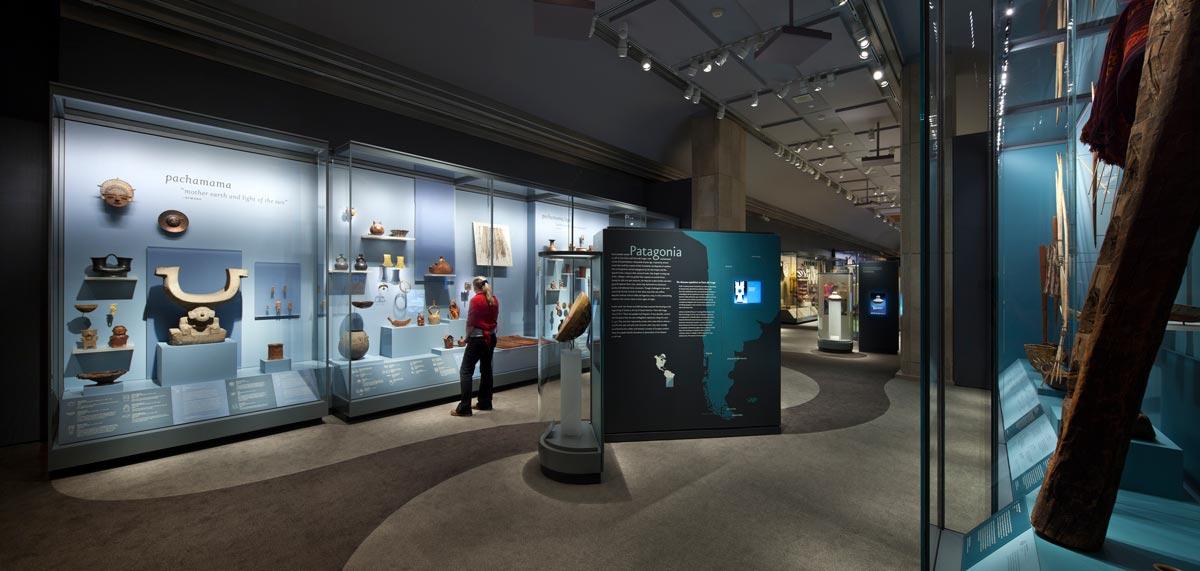
The “Infinity of Nations” exhibition at the NMAI in New York features items from across the Western Hemisphere.
Photo by NMAI staff

This double-spout ceramic drinking vessel in the shape of two fruits from Peru was the first item in the exhibition discovered to have crystals growing on it (above). These were successfully removed (below). Drinking vessel, Nazca; (A.D. 100–450), 1944; cotton canvas, wood and casein paint; 4" x 2" x 5". 17/8902
Photo by NMAI staff

Feathers such as these on this shirt’s shoulders can easily catch small particles of dirt and are some of the most challenging materials to clean.
Mans shirt from Crazy Horse (Oglala Lakota); circa 1875; hide, hair, feathers and paint; 33.5" x 55". 16/1351
Photo by NMAI staff
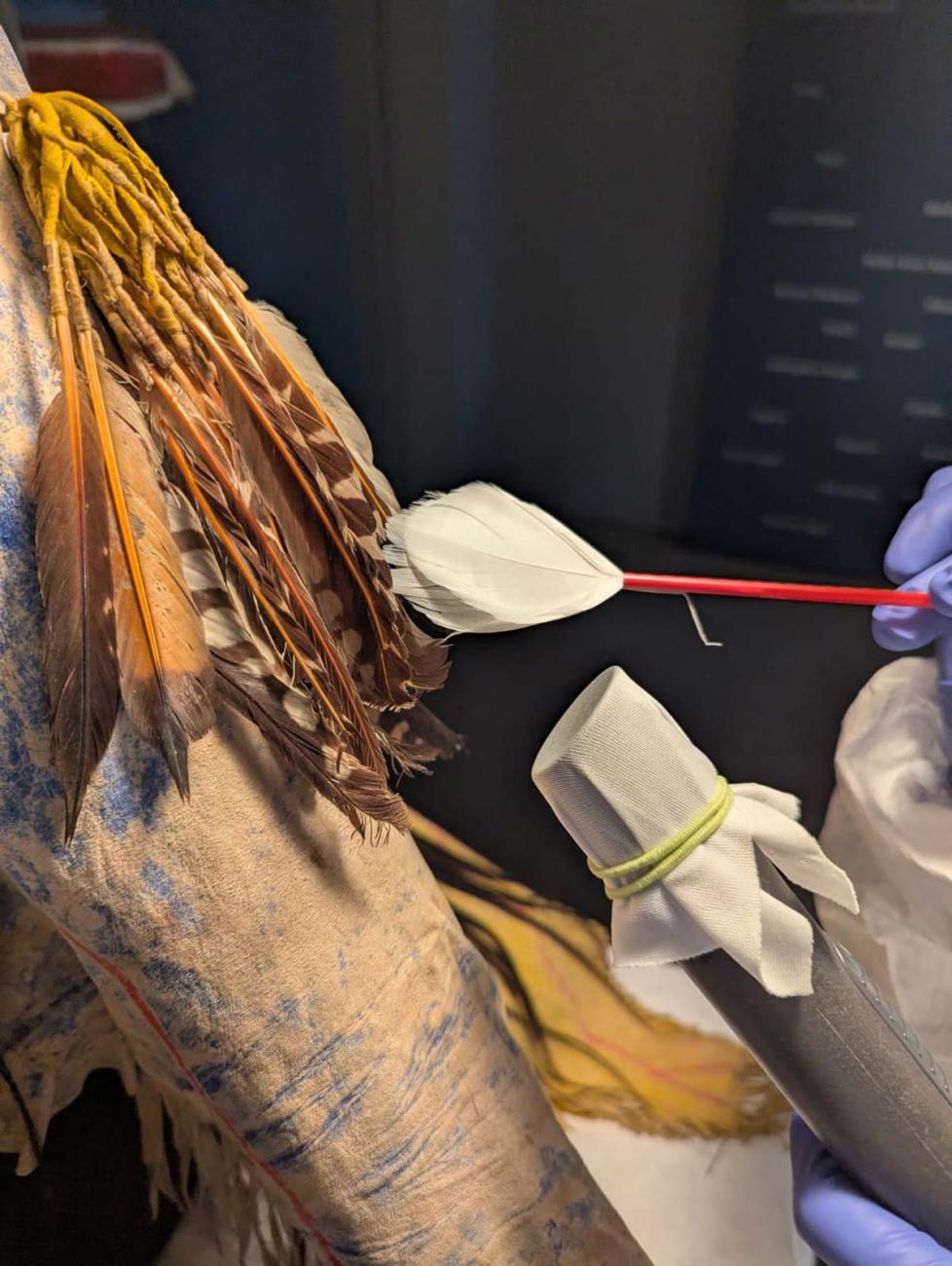
Yet because feathers have barbs, using a feather attached to a straw can clean feathers and other delicate materials.
Photo by NMAI staff
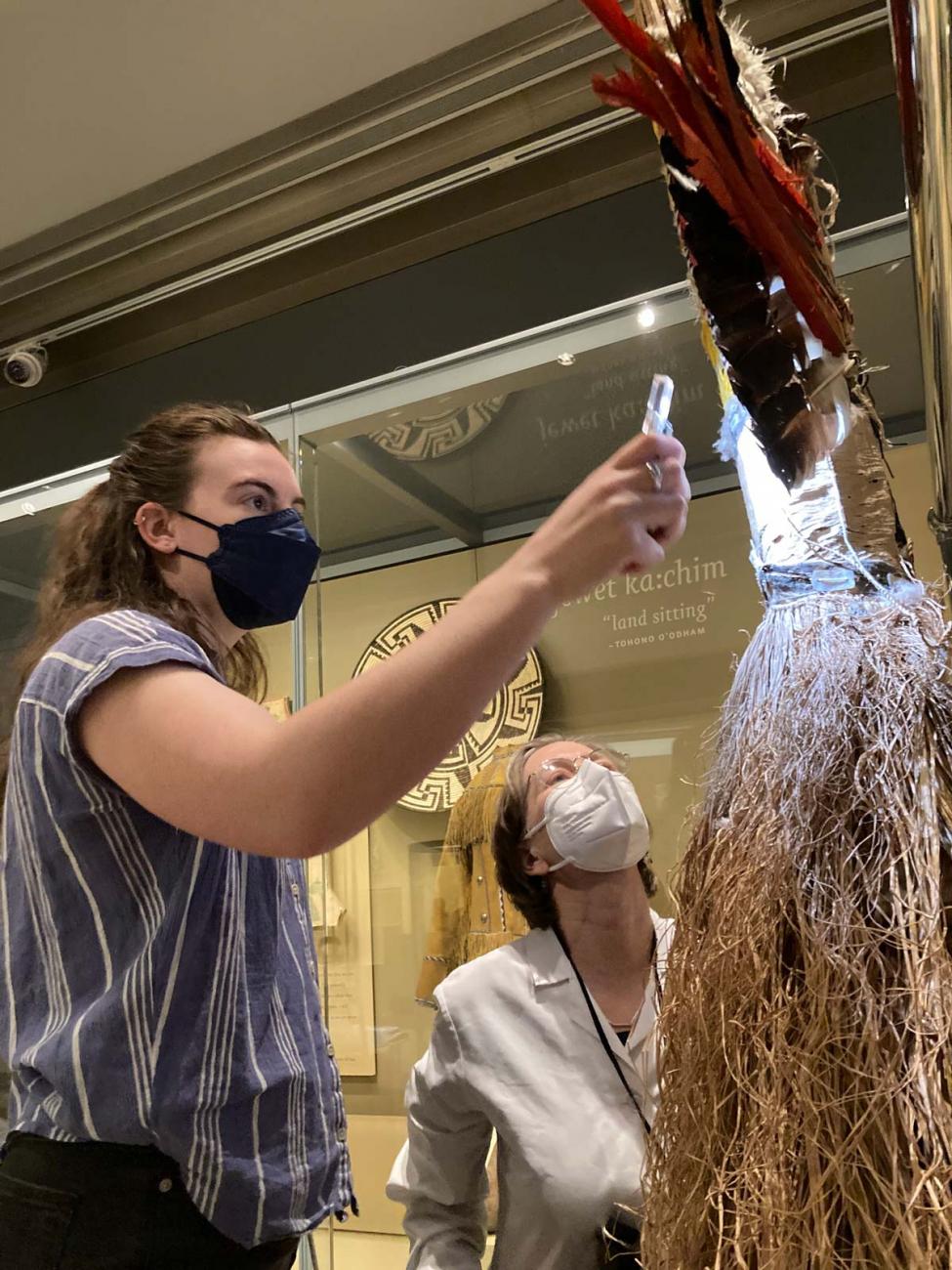
Erin Birdsall shines the flashlight from her cellphone onto feathers on a mask collected in Brazil so she and Susan Heald (right) can look for any glittering crystals. Mask, Karaja ijaso; 1930-1960; reed, feathers and gourd; 67" x 21" x 8.6". 23/2000
Photo by NMAI staff
On a shelf near the far top left corner of the display case was a ceramic Nazca drinking vessel from Peru dating to more than 1,500 years ago. It’s two mouth pieces looked initially to be covered in dust, but upon bringing the jar down from its perch, the mysterious particles looked fuzzy. Some of the white fluffy substance tumbled off the jar like freshly fallen snowflakes, yet they felt waxy. The staff was stunned. The case had not been open recently, and all the pieces were clean when they were put on display. Only after examining it closely under a bright light could they see the “fuzz” was actually clumps of glittering crystals. “It sparkled, like the vampires in the Twilight movies,” said NMAI’s Head of Conservation Susan Heald.
Museums are constantly battling virtually silent and invisible nemeses. The first is time. Even though all objects are kept under strict temperature controls in drawers, some natural materials such as leather eventually lose their elasticity and are vulnerable to degradation. In museums’ early days, collections were often treated with naphthalene (moth balls) to keep away unwanted pests, which leaves an unpleasant odor that can last for decades. Ledgers of the collector George Gustav Heye, who in 1916 founded the Museum of the American Indian-Heye Foundation that preceded the NMAI, showed “he would buy 200 to 600 pounds of naphthalene moth flakes a year,” said Heald.
Rather than using chemicals, today the NMAI museums in New York and Washington, D.C., as well as NMAI’s Cultural Resources Center in Maryland that houses the more than 800,000 items in the NMAI collection are constantly being cleaned to remove any danger of attracting moths or carpet beetles that can break materials down. But this sparkly invader was something entirely new to NMAI.
Still, Heald had a suspicion of what it was. Just weeks earlier, she had read an abstract of an article describing this phenomenon: “efflorescence crystals” were found growing on rubber sealing gaskets, interior glass doors and items within display cases at several other museums in the United States and other countries. To confirm the identity of the substance, the staff took a sample and sent it to Smithsonian’s Museum Conservation Institute (MCI), which verified this was indeed what they were seeing.
Ironically, the very cases built to protect the items within were the culprits. Between 2009 and 2014, some case manufacturers used automotive adhesive to bind glass together in its display cases. Because the cases were air-tight to block pests or other destructive elements, they had no ventilation. In the closed environment, the adhesive began to off-gas a volatile organic compound, a toxin that can irritate eyes, throats and skin while encouraging the crystals to grow.
Yet replacing these enormous, heavy cases on the second floor of the old building without a freight elevator would have been a Herculean task that would have cost millions. “They are beautiful, high-quality cases. They just have this unfortunate adhesive that isn’t being used anymore,” said Heald.
The only option was to find ways to remove the crystals within them. In 2020, they received some funding to gather a team to search every case and document where the crystals were. But then the COVID-19 pandemic hit, and the museum was shut down for months. So NMAI Collections Manager John George and intern Sarah Elston took on the job of surveying the exhibition.
The team found that, unlike in other museums, the crystals were not on gaskets inside the cases but rather on about a third of the objects in the exhibition—with no obvious pattern. The crystals were not picky: they grew on ceramic, stone, wood, feathers, furs, textiles, tanned hides, plant fibers and seeds. They tended to prefer more ancient items but were also thriving on historic and contemporary pieces. The only common factor seemed to be that at some point many of the items with crystals must have been touched or used by humans, leaving oil or sweat residues behind. George said, “Crystals are forming on top of that presence of that original person. Blood, sweat and tears go into these pieces, and this is where you can visibly see it.”
The problem was perplexing. Staff endeavored to completely clean the cases and the objects within and air the cases out to prevent the crystals from regrowing, but “soon as you shut the case, it built up again,” said Heald.
In 2022, the museum and the MCI received additional funding from Smithsonian’s National Collections Program (NCP) that enabled conservation staff to travel to New York to inspect and investigate ways to clean the items and keep them on display. But removing the crystals without damaging very old and delicate materials such as cedar bark, feathers or cotton fabric hundreds of years old was no easy task. They ended up fashioning some creative tools.
Donning gloves, goggles and other protective gear to not be affected by the toxic crystals, the team got to work. They would use a rubber band or hair tie to attach a piece of fabric over a vacuum cleaner nozzle so they could suck up dust and crystals yet not any tiny pieces of items within the cases. Soft, slightly damp cosmetic sponges and swabs helped remove remaining residue from hard surfaces such as a wood mask or a ceramic pot. However, cleaning feathers or fragile, painted fibers was a whole other challenge. “Cleaning the feathers is so hard,” said Heald. But because feathers have barbed hooks, they also are the perfect tool to pick up and trap tiny particles such as dirt on other feathers.
Heald found what she needed in Manhattan’s garment district. A colleague at the American Museum of Natural History had told her they had been using feathers to clean delicate items. “I went to the store that only sells feathers and asked for a particular feather. They have to be white and soft, like a swan feather, so we can see any dirt,” Heald explained. She ended up buying four different types of feathers and attaching them to paper, cocktail and coffee straws to make feather brushes that could be used to painstakingly clean fragile materials. “Some things like a small stone might take 15 minutes to clean,” said Heald “but there is a skirt made of condor feathers, for example, that took two of us a day and a half.”
Once they are done for the day, staff wipe surfaces down with a water and alcohol solution. Altogether, the many cleaning methods have significantly reduced the number of crystals.
The funding also enabled them to tap into the skills of a post-doctoral chemistry student, Erin Birdsall. As a NMAI and MCI fellow until June 2025, she was tasked to analyze the crystals as well as the success of the cleaning methods. She was continuing the work of Alba Álvarez-Martín, then a post-doctoral conservation science fellow at MCI. Now Birdsall continues to work on the project as needed as a MCI fellow and heritage scientist.
To determine whether the adhesive was off-gasing in a case, she needed to test the air quality inside. Each chemical has a known weight and mass. Birdsall used a mass spectrometer to identify the toxic compound in cases throughout the exhibition.
The team decided the only solution to preventing the crystals from growing would be to constantly filter and circulate the air in the cases. They tried several filtration units and setups before landing on a type of filtration unit with a fan. The large cases had some space beneath their bottom deck where the units could sit and a thin gap between the glass and deck that would allow air to circulate. Others had to be retrofitted to find a place for the air filtering units and add electricity to run them.
Once an item had been cleaned, the NMAI staff still needed a simple way to verify that all the crystals had been removed before putting it back in a case. They discovered that shining the flashlight from a cell phone onto an item would cause its crystals to sparkle, revealing their location. To test cleaning methods, Birdsall used solid phase microextraction. This involved placing a tiny fiber resembling a piece of pencil lead on a surface and then running it through a gas mass spectrometer that, through extremely hot gas, breaks down any materials on it into separate chemicals. If this showed the components of the crystals, then some remained; otherwise the item was clear.
Heald was grateful that Birdsall was on the team. “Having a chemist was critical to solving the problem,” she said.
Because the crystals were growing on all different types of materials, Birdsall said “we expected them to all be slightly different, like different flavors for each material, but they are all the same, which was crazy.” So Birdsall is still trying to determine the exact chemical reaction that cause these crystals to grow.
Since the installation of the air filtration systems, however, the crystals have yet to return. Although the NCP funding has ended, NMAI and MCI staff continue monitoring the cases and will replace the air filters as needed. In 2026, the conservation and exhibition staff will finally be able to add new items to the exhibition again. As they were working in the exhibition space, visitors could watch and ask questions. “Showing the public how we are solving this problem was very positive,” George said.
Members of the team have published journal articles about their investigations and shared their approach to cleaning the items and cases with other museums around the world, including some others at Smithsonian that have had some crystallization issues. “It has been a learning experience to see how we are all tackling this together,” he said, “but I think we are leading the way.”
The team is also aiming to put together some care guidelines for Indigenous communities so they can be aware of the situation and the remedies the museum staff developed to care for their belongings. Birdsall said, “We want to make sure these items are as safe as possible and that we are handing them off in the best possible condition.”
Heald said, “After 10 years, we are moving forward. We can do item rotations and returns to communities safely. We’ve had an incredible journey, with many walking with us along the way.”