
The comic strip “G.I. Gertie” featuring a fiesty member of the Women’s Army Corp (WAC) during World War II might have easily been about the illustrator who drew it. In her biography “Eva Mirabal: Three Generations of Tradition and Modernity at Taos Pueblo” by her son, artist Jonathan Warm Day Coming, and curator Lois P. Rudnick, she is described as “headstrong, self-assured, good-humored and ambitious.” Her passion for her art drove her to create many paintings and illustrations depicting her Pueblo culture, in spite of her career being cut short.
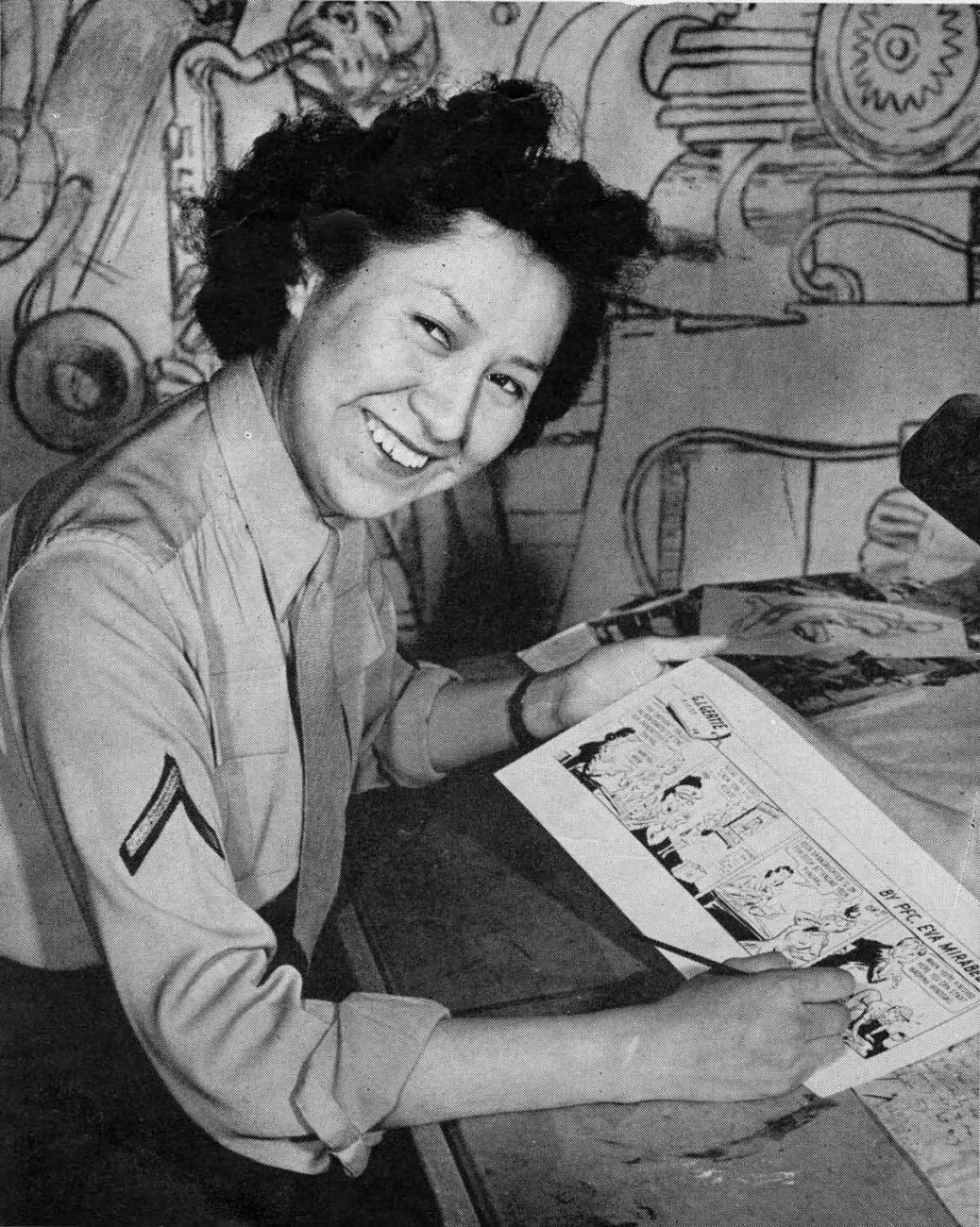
Eva Mirabal drew the “G.I. Gertie” comic strip and painted many murals for the U.S. Air Force during World War II (below), leading to a commission of this dressing screen.
Photo by U.S. Army, Courtesy of National Archives at Denver

Eva Mirabal drew the “G.I. Gertie” comic strip and painted many murals for the U.S. Air Force during World War II (below), leading to a commission of this dressing screen (right).
Three-paneled screen, Eva Mirabal (Eah Ha Wa, Taos Pueblo), 1944; cotton canvas, wood and casein paint; 61" x 69". 24/6895
Photo by NMAI Staff
Born in 1920, Mirabal (named Eah-Ha-Wa, or “Fast Growing Corn”) grew up with her family in Taos Pueblo in northern New Mexico. Her father, Pedro, who modeled for artists, gave Mirabal her first art supplies. From 1936 to 1942, she attended the Santa Fe Indian School, a boarding school where she studied under painter Dorothy Dunn. From her, she learned the “studio style” or “flat style” of painting that Dunn felt reflected Pueblo designs found on murals, pottery and rock art. Mirabal adapted these techniques but made them her own, so that, Dunn once wrote, she “had the ability to translate everyday events into scenes of warmth and semi-naturalistic beauty.”
After winning a poster contest the U.S. Treasury Department sponsored for war bonds, Mirabal enlisted in the U.S. Army in 1943. A private, she became the WAC’s only full-time artist, drawing “G.I. Gertie” for “AIR WAC,” a U.S. Air Force newspaper, and painting murals for the Wright-Patterson Air Force Base where she was stationed in Ohio. She worked under muralist Stuyvesant Van Veen, who commissioned her to paint this dressing screen for his first wife, Frances, in 1944 (far right), the only such work she is known to have created. She was a sergant by the time she was discharged in 1946.
Mirabal would go on to teach art at Southern Illinois Normal University. Yet only a year later, in 1947, her mother’s illness drew her back to Taos. There, the GI Bill allowed her to study at the Taos Valley Art School until 1951.
During her lifetime, Mirabal’s work was exhibited at many museums and institutions, including the Addison Gallery of American Art, Dayton Art Institute, Philbrook Museum of Art and St. Louis Art Museum. In 2015, the U.S. Army Women’s Museum honored Mirabel for her military service.
In 1950, Mirabal married Manuel Gomez and they had two sons, Christopher and Jonathan. Although Mirabal died in 1968, when Jonathan was still young, he recalled, “I always remembering her smiling, doing her artwork at her drawing table.”