When Native American artists started experimenting with glass during the 1970s, they were enthusiastic to create in what was for them a new medium. Yet they found the market for their artworks tough. Many collectors and critics thought they were not “authentic Indigenous art.”
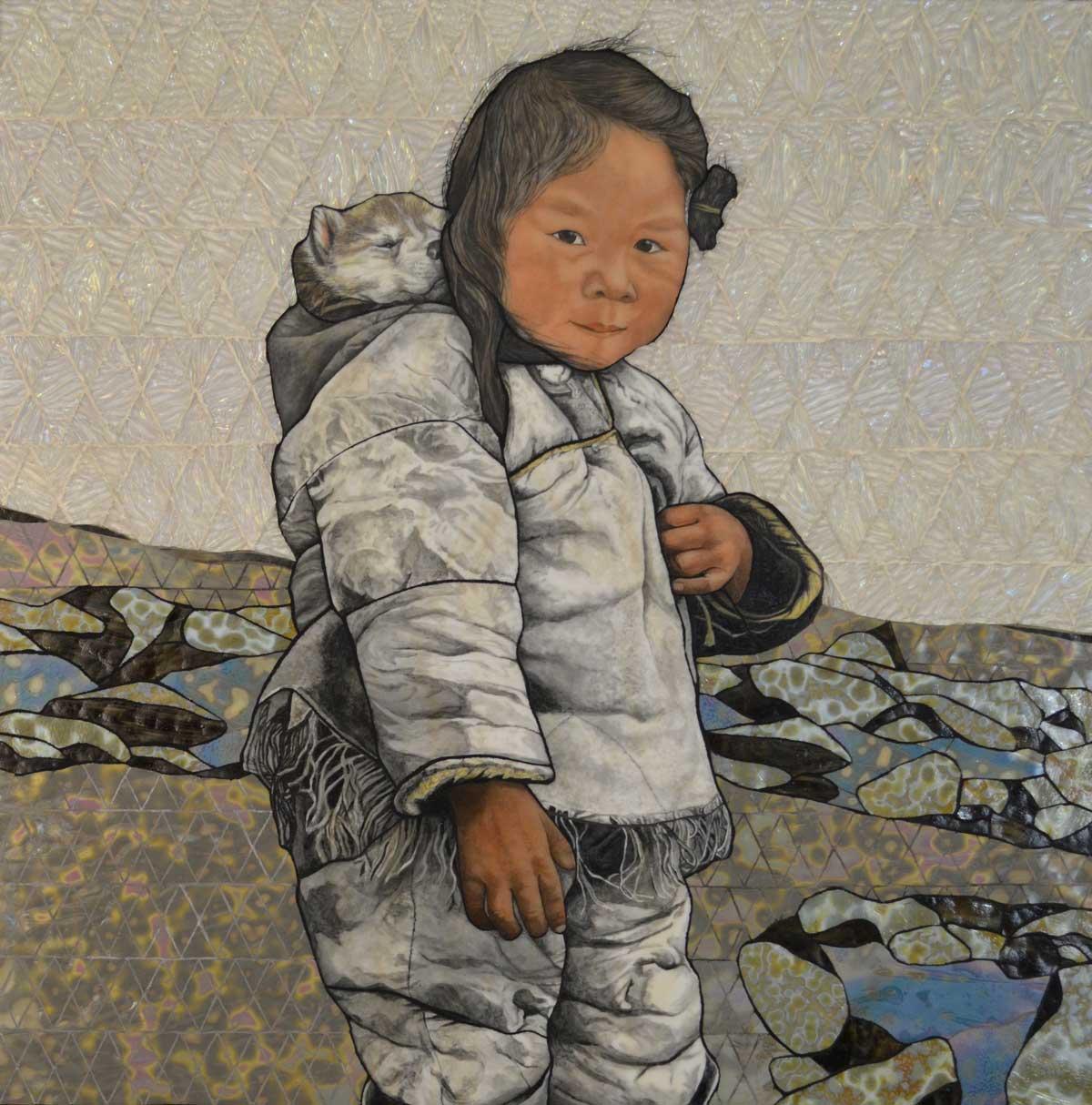
Angela Babby’s portraits, such as this Inuit girl with her Husky puppy, are enameled-glass mosaics—glass-on-glass that brings a saturation of color and luminosity to her art.
“Melt: Prayers for the People and the Planet,” Angela Babby (Oglala Lakota), 2019; kiln-fired vitreous enamel on glass mosaic on tile board, 30" x 30".
Photo by Angela Babby
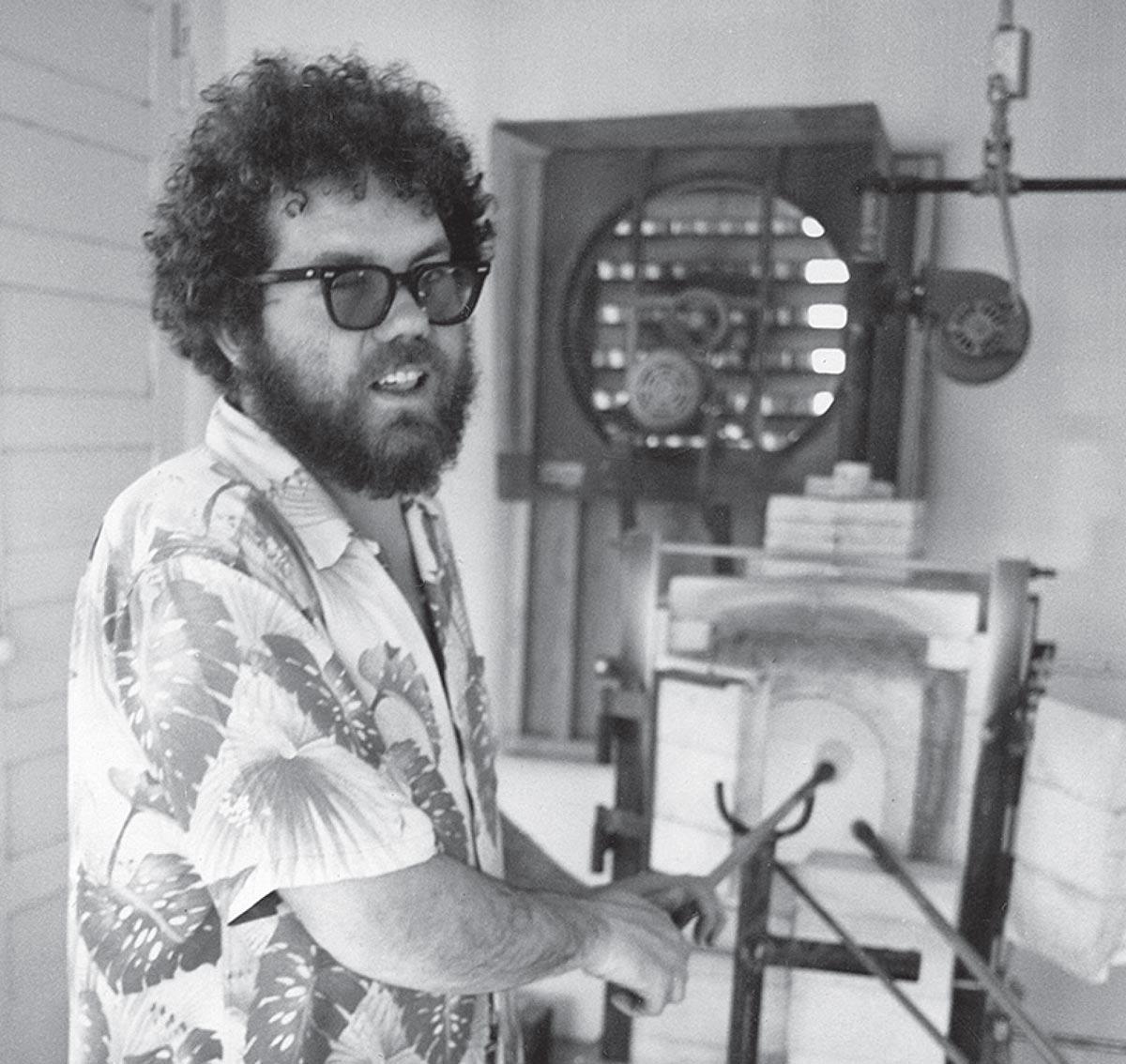
Dale Chihuly taught many Indigenous students how to blow and fire glass at the hot shop he created for the Institute of American Indian Arts in Sante Fe, New Mexico, in 1974. His works include glass baskets.
Photo courtesy of the Institute of American Indian Arts

Robert “Spooner” Marcus (left, Ohkay Owingeh) working with Tony Jojola (Isleta Pueblo) on a glass piece at Taos Glass Arts and Education in New Mexico circa 1999.
Courtesy of Tony Jojola
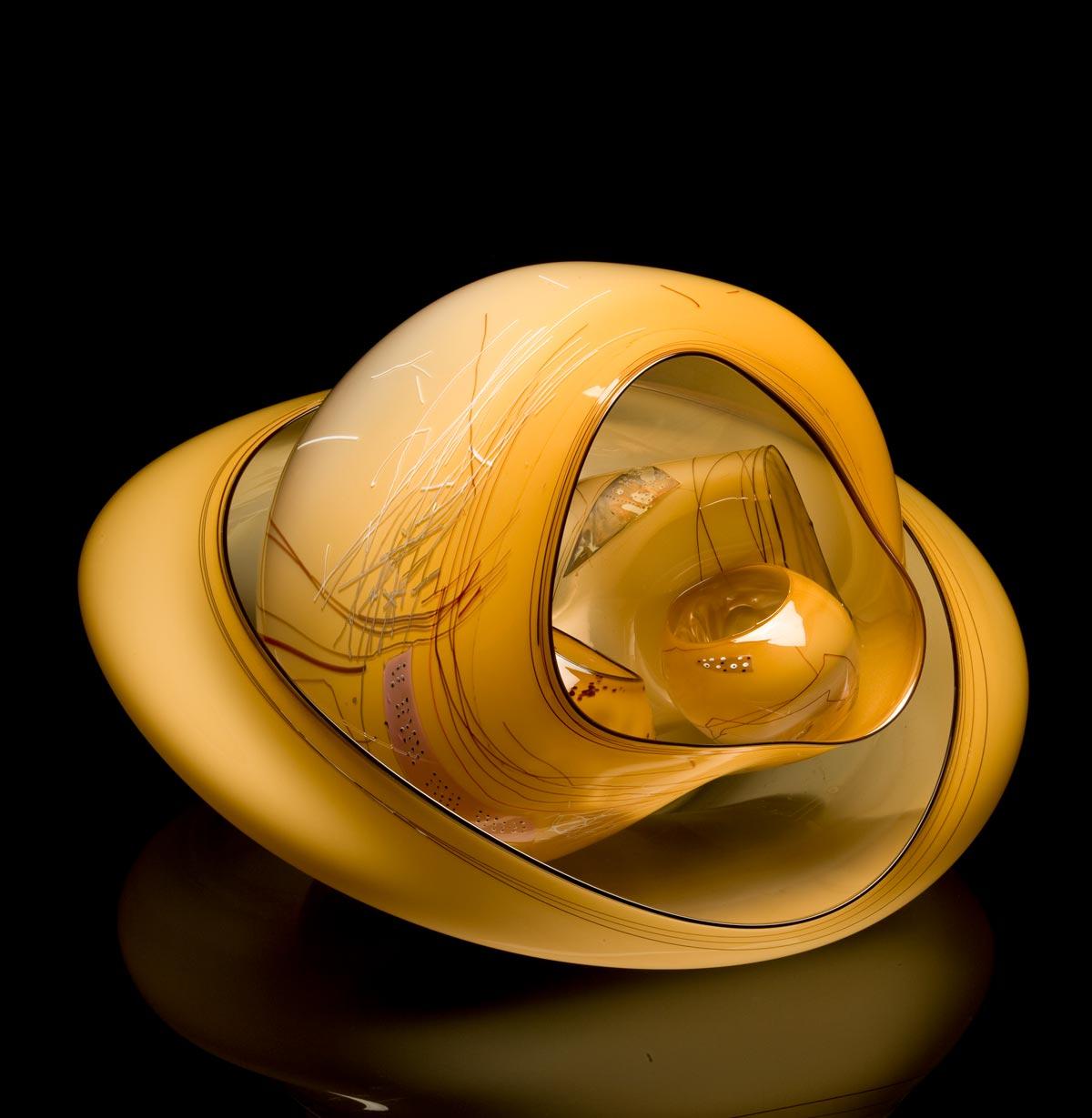
“Tabac Basket Set with Drawing Shards and Oxblood Body Wraps,” Dale Chihuly, 2008; blown glass; 13" x 27" x 30".
Courtesy of Chihuly Studio

Untitled, Tony Jojola (Isleta Pueblo), 2014; blown glass with silver stamps, 8.1" x 7.8".
Courtesy of Tony Jojola
Five decades later, these spectacular works and those of other Indigenous artists are being showcased in studios and museums around the world, including in the exhibition “Clearly Indigenous: Native Visions Reimagined in Glass.” Originating at the Museum of Indian Arts and Culture in Santa Fe, New Mexico, the exhibition will be on display at the National Museum of the American Indian in New York City through May 29, 2026. It features works from 33 Indigenous artists as well as one who, although not Native, inspired many others to become glassmakers.
A Merging of Movements
Many Indigenous artists have launched their careers after attending the Institute of American Indian Arts (IAIA) in Santa Fe, New Mexico. Cherokee textile artist and fashion designer Lloyd Kiva New co-founded the institution with George Boyce in 1962 as a high school. During the early 1970s, they developed accredited college courses for its students and invited art instructors to teach there.
One of those professors was Dale Chihuly. He had studied under leading glass artist Harvey Littleton, who is considered a founder of the studio glass art movement. Chihuly co-founded the Pilchuck Glass School in 1971 in Stanwood, Washington, a town about 50 miles north of Seattle. Chihuly continued teaching at the Rhode Island School of Design and then at IAIA in 1974 as a visiting professor.
Although Chihuly is not Indigenous himself, he found Native cultures and art inspirational. He built the IAIA’s first “hot shop”—a glassblowing studio that includes a furnace for melting glass—and taught its first Indigenous students how to blow glass. This involves dipping the end of a steel pipe into molten glass. The glassmaker will then blow into the pipe to expand the glass into a cylinder, which is then further shaped with multiple tools. The finished piece will be carefully tapped off the pipe and cooled.
Chihuly had spent time with glass masters in Europe who often worked collaboratively, so while in the United States early glass art was based on a single artist’s work, Chihuly evolved the process to include many techniques and a team approach. “I’ve always worked and taught within a community of artists and think that it’s important for artists from all over the globe to be exposed to one another, to gain confidence and creativity through connection,” wrote Chihuly in an email interview.
Tony Jojola (Isleta Pueblo) was inspired by Chihuly’s teachings. In 1994, Chihuly co-founded Hilltop Artists, a school for youth from various cultural and economic backgrounds, in Tacoma, Washington, with Kathy Kaperick. She in turn created the Taos Glass Arts and Education program with Jojola in New Mexico in 1999. Several Pueblo artists working in glass today came out of this program.
Other first-generation Indigenous glass artists include Larry “Ulaaq” Ahvakana (Iñupiaq) and Carl Ponca (Osage). They in turn taught or inspired a second wave of leading Indigenous glass artists, such as Daniel and Raya Friday (Lummi), Ira Lujan (Taos/Ohkay Owingeh), Robert “Spooner” Marcus (Ohkay Owingeh), Raven Skyriver (Tlingit) and Preston Singletary (Tlingit).
Singletary’s first experience with the art of glassmaking was serving as a night watchman at a glass works studio. He not only protected the shop but also prepped the kilns to heat and made sure the artists’ tools were ready for work the next day.
While he only spent about six months in that job, it motivated him to learn more about glassmaking. His first pieces were similar to a small drinking cup—just a cylinder with a handle—and colorful egg shapes. He has since achieved creating complex glass sculptures that are several feet tall and have intricate designs reflecting his Tlingit culture. This often requires assistance from his shop team. He has also collaborated with other artists to co-create works.
“The more complex forms you want to make, the larger the team has to be,” Singletary said. “A lot of people when they watch glassblowing, they think it looks like dancers. You look like you’re moving together in symbiosis. And it’s true. Once you get a great team that works together on a regular basis, it is very understood what needs to happen.”
A Glassmaking Evolution
While the first generations of Indigenous glass artists began with hot glass blowing, they went on to use other kinds of glass and techniques. “Warm” glass, which is fired in a kiln at lower temperatures, can be more like the texture of honey and can be fused with other glass or “slumped” over a mold. Pieces of “cold” glass, or that which is already formed, can be used to create works such as stained glass.
Diné artist Carol Lujan, who works with fused “cold” glass and clay, said she was introduced to glass art in a clay workshop in 2013 at the Santa Fe Clay studio.“Working with glass is both challenging and rewarding. There are times when I make mistakes in cutting the glass, and also times when my pieces crack in the kiln. However, these types of issues only encourage me to learn more about preventing problems regarding glass cutting and the firing process.”
Like Inuit carvers, some who have said the soapstone reveals what it wants to reveal, glass artists let the glass reveal the colors and light that come into play when they are working on their creations. And sometimes, even they are surprised by the revelation.
Singletary discovered the play of light almost by accident. He was working on a North Pacific Coast hat with a large brim that comes to a flat point. Upside down, it resembles a bowl. “I put it up on a pedestal and then these shadows came through and it was the ‘aha’ moment where I saw a secret behind the piece,” said Singletary. “As the sun shines through it,” he said, “it casts these long kind of abstract, elemental forms that change throughout the day.”
Lujan agreed that the interaction between glass and light can change how a work is viewed. She said, “It is almost magical to see how light can enliven glass and bring out the brilliance of the colors, and, conversely, how glass can absorb and reflect light.”
Reflecting Stories
Letitia Chambers, former chief executive officer of the Heard Museum in Phoenix, Arizona, remembers the first piece of Indigenous-made glass art she ever saw. It was a Preston Singletary artwork at the Santa Fe Indian Market, one of the most prestigious juried shows for Indigenous art. “The color was so, so gorgeous and so beautiful and luminescent that I purchased it in the auction,” said Chambers.
This was around the same time Kiva New asked if Chambers would be interested in writing a book about Indigenous glassmakers. But she would only be able to devote her time to this project after she retired and moved to Santa Fe, where the Southwest Association for Indian Arts hosts its Indian Market each August. So in 2017, Chambers invited several glass artists to a meeting there to discuss the possibility of an exhibition and a book. “They were very excited by it,” said Chambers. “As I was interviewing artists, I would discover they knew of other artists that I hadn’t known about.”
She would go on to author the book “Clearly Indigenous: Native Visions Reimagined in Glass,” which was published in 2021, and co-curate the accompanying exhibition with Potawatomi textile artist and museum consultant Cathy Short, which opened at the Museum of Indian Arts and Culture in 2022. This show could have ended there, but Chambers said people who had seen it wanted to know when it was going to start traveling. She also wanted the stories that are in each of the pieces to be shared. So she worked with the NMAI to adapt the exhibition for its opening there in November 2025.
The works in the exhibition are as different as the artists who created them, yet one can see a common theme: just as glass can absorb and reflect light, these artists who know their peoples’ stories have used their exceptional skills to project them. Among them are a bowl that shows weaving techniques of a Lummi basket of the Northwest Coast, a glass “rug” with Diné designs of the Southwest and a sculpture of a bird craning its neck from Australia. “It’s really an incredible group of artists,” said Chambers.
Clearly Indigenous: Native Visions Reimagined in Glass
The stunning pieces of glass art in this exhibition document the fusion of the Contemporary Native Arts movement and the Studio Glass Art movement. The result is an extraordinary new genre characterized by the intellectual content of Indigenous material culture and expressed through the dynamic properties of glass.
Solid in color or layered, glass can be transparent or opaque. It can be worked hot, warm or cold; it can be blown, cast, slumped, sandblasted, melted over a flame, or kiln fired; it can be ground, etched, engraved, painted, polished
or fused.
Regardless of the methods used, the art created is a personal expression of the artist. For Indigenous glass artists, inspiration may stem from everyday items, such as pots or baskets, or from traditional stories or oral histories. It can also express itself as the interpretation of cultural heritage, as honoring and giving voice to ancestors, or as commentary on contemporary issues affecting Native communities or society at large.
This exhibition presents glass art made by Dale Chihuly and 29 Indigenous artists from 26 Native nations from the United States and Canada as well as two Māori artists from New Zealand and two Aboriginal Australian artists. The selection of these works that follows is adapted from the “Clearly Indigenous” exhibition and its accompanying book of the same title.
Northwest Coast Vessels Reinterpreted in Glass
Indigenous communities along the North Pacific Coast harvest bark, grasses and wood from dense forests and oceanside landscapes to make a variety of everyday items from woven natural fibers. The painstaking process of collecting and preparing the organic materials results in lasting, high-quality wares that families can use daily over time.
Salish, Tlingit and other Northwest Coast artists have reinterpreted centuries-old baskets, bags
and wooden house posts and boxes in blown and woven glass.
Dan Friday (Lummi)
Dan Friday is a leading glass artist and teacher of glassmaking. He incorporates his culture into his work that, as described in the book “Clearly Indigenous,” often depicts “stylized birds, fish or other creatures that are prominent in the history or stories of his tribe.”
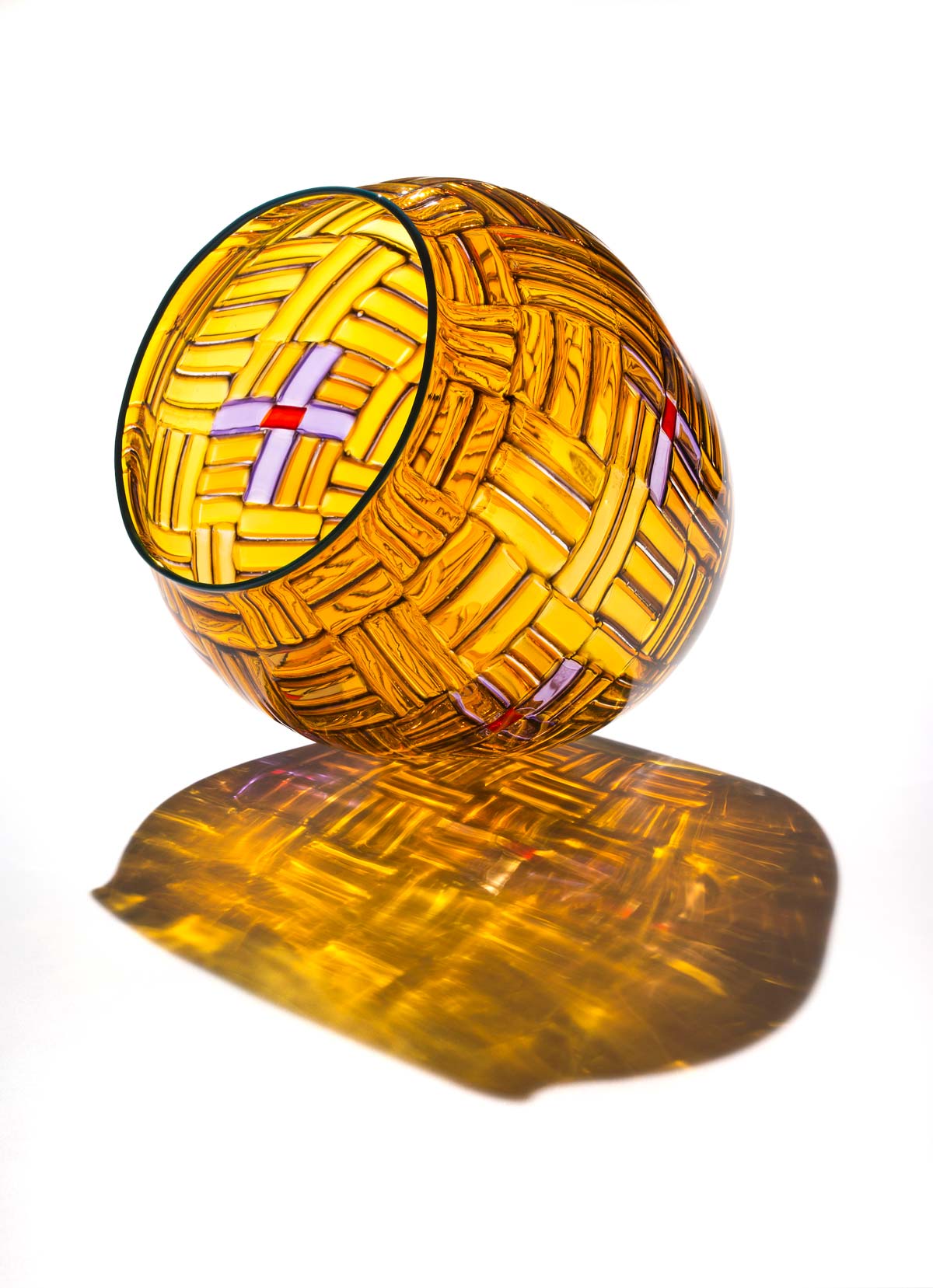
“Aunt Fran’s Star Basket,” Dan Friday (Lummi), 2017; hand-blown glass veil canes, 16" x 14" x 14".
Photo by Russel Johnson/courtesy of Friday Glass
Raya Friday (Lummi)
Raya Friday is the younger sister of Dan Friday. Raya studied at Alfred University in New York, majoring in glass sculpture. She began working at the Glass Eye Studio in Seattle, Washington, and then as the head of research and development at the glass votive company called Glassybaby. Today, Raya creates delicately crafted works such as this “Lattice Basket” as well as large-scale glass installations.
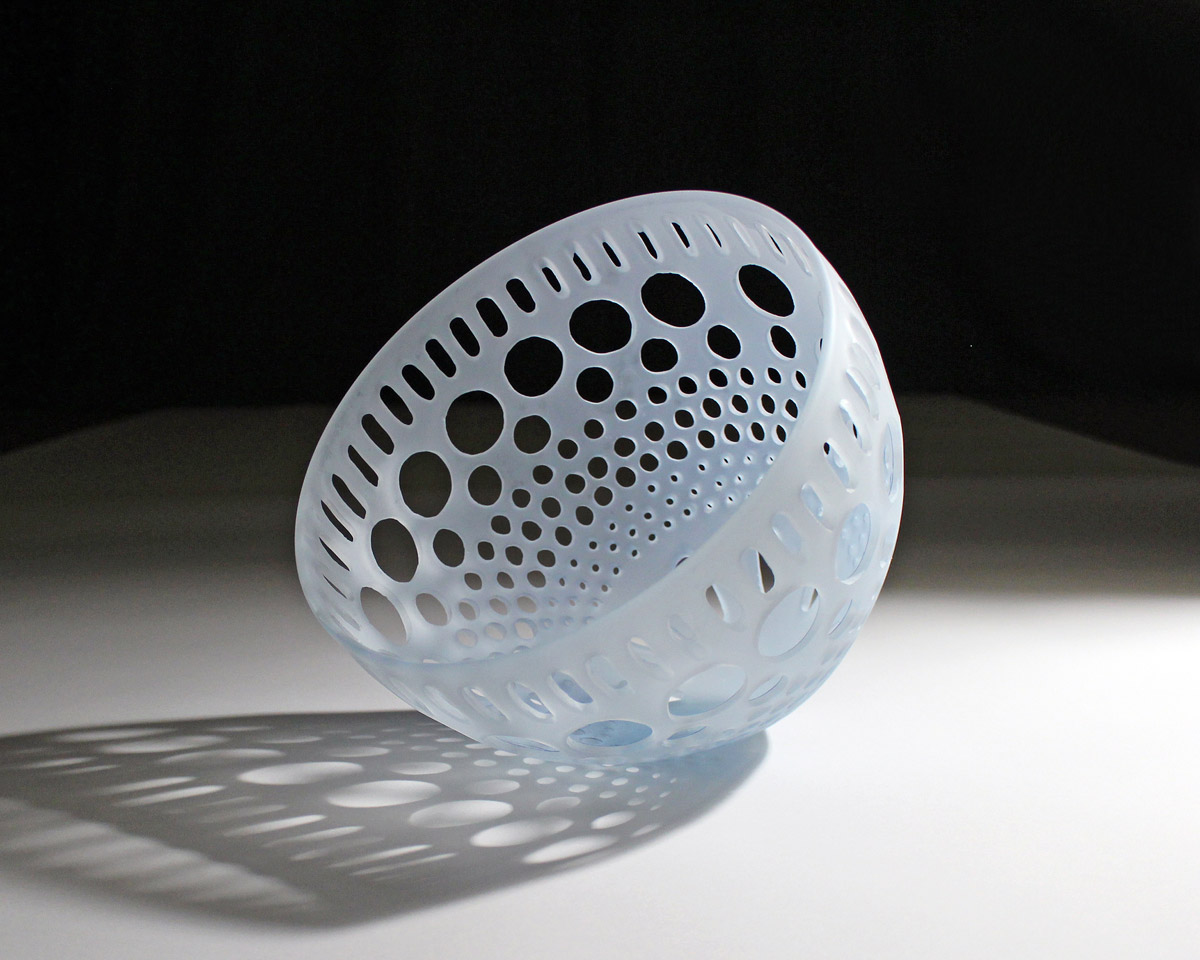
“Lattice Basket,” Raya Friday (Lummi), 2017; blown and sculpted glass, 13" x 11".
Photo by Kitty Leaken/Courtesy of the Museum of Indian Arts and Culture
Pueblo Pottery Recreated in Glass
Pueblo peoples of New Mexico have created vessels made of clay for millennia; however, several contemporary Pueblo artists have chosen to work in glass as their primary medium. Others who generally work with clay have collaborated with glassblowers to create works of art that incorporate Pueblo pottery designs onto blown glass vessels. Shapes created in glass known as ollas, seed jars and wedding vases, whether designed with ancestral or more contemporary motifs, are distinctly Pueblo.
Robert “Spooner” Marcus (Ohkay Owingeh)
Robert Marcus is a fourth-generation artist. His great-grandmother helped revive traditional pottery making at his Ohkay Owingeh Pueblo in New Mexico. His entry into glass art was serendipitous, when he was hired at the Glass Improvement Studio in New Mexico. He is known for his glass vessels.
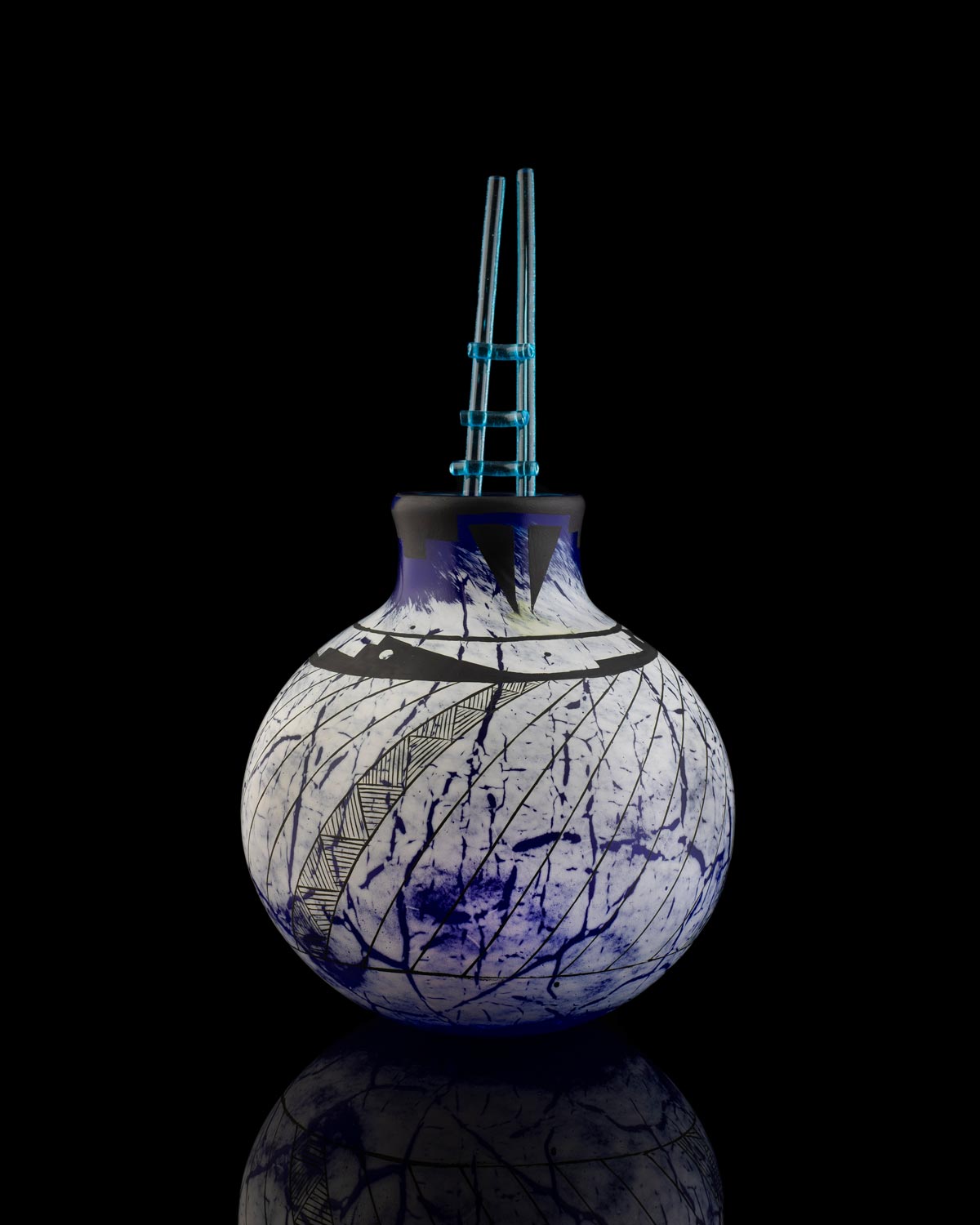
“Kiva Ladder,” Robert “Spooner” Marcus (Ohkay Owingeh), 2018; blown and enameled glass, 23" x 8".
Courtesy of Robert “Spooner” Marcus
Cultural Heritage Integral to the Art
Indigenous glass artists are part of the continuum of generations that have incorporated cultural knowledge and community or family designs into new artistic forms. Although the means and modes of creating art change with time and availability of materials, cultural heritage remains integral to the artistic process, as seen in this Pueblo pot.
Preston Singletary (Tlingit)
Preston Singletary’s creations are produced with exceptional technical skill. In 1984, while enrolled at the Pilchuck Glass School, he studied with several major European artists. But when he met other Indigenous glass artists, he decided that his art would reflect his Tlingit culture. He has often collaborated with other glass artists, such as Tammy Garcia.
Tammy Garcia (Santa Clara Pueblo)
Tammy Garcia originally worked with clay. She and her husband opened their Blue Rain Gallery in Sante Fe, New Mexico, where she met Preston Singletary. The two artists began working together on this piece in 2005. Together, they transformed her clay vessels into glass ones with brilliant colors.
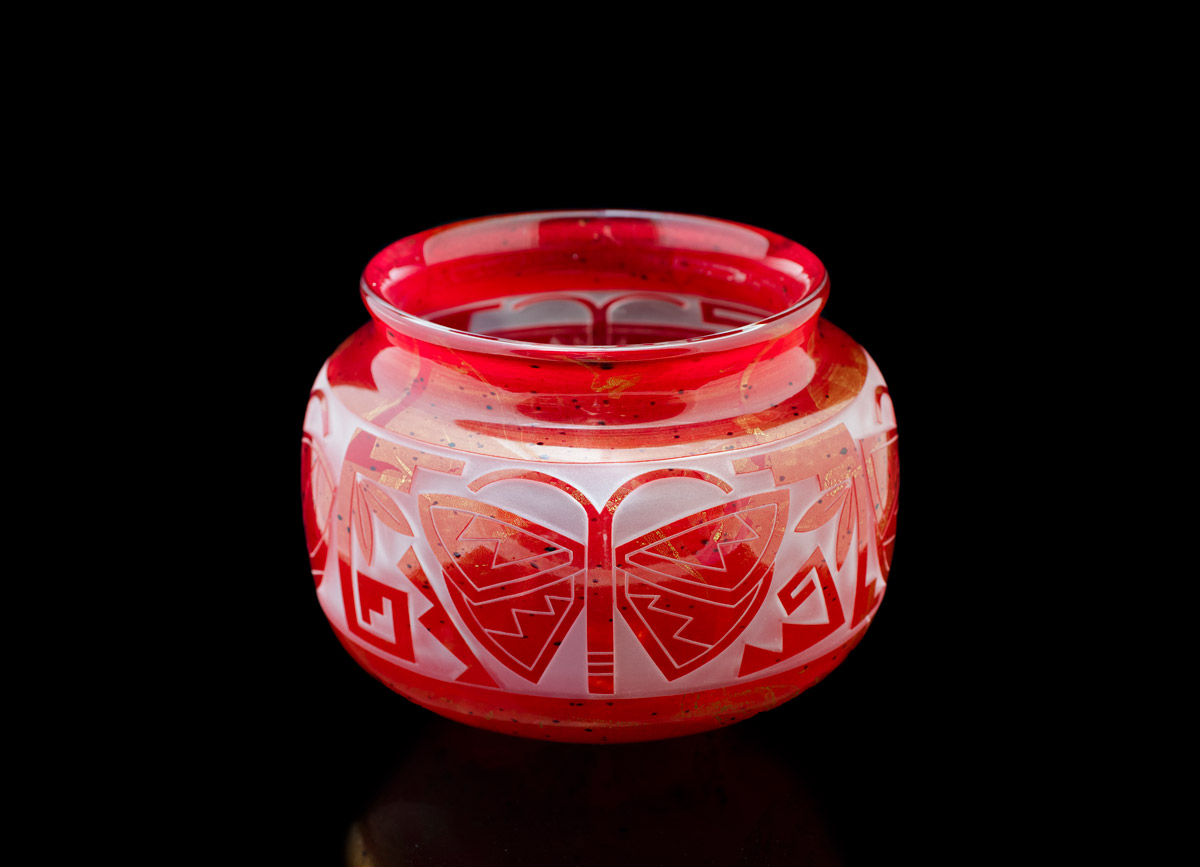
Untitled, Preston Singletary and Tammy Garcia, 2008; blown and sand-carved glass, 8.5" x 10".
In the collection of Meilee Smuthe, Scottsdale, Arizona.
Photo by Wendy McEarhern; Image courtesy of Preston Singletary and Tammy Garcia
Textiles Reimagined in Glass
These glass objects reflect the importance of creating textiles to Indigenous communities. Spindle whorls for spinning threads as well as woven panels with fiber designs have been reinterpreted in glass using molds or slumping—a process that heats the glass until it droops, or “slumps,” over or into a mold.
Susan Point (Musqueam)
Susan Point is credited as one of a handful of artists who revived the art and design of Coast Salish peoples in southern Vancouver, Vancouver Island and northern Washington state. During the 1980s, Point began creating three-dimensional art in a variety of mediums, including glass. Her work represents historic art forms and imagery of the Coast Salish people.
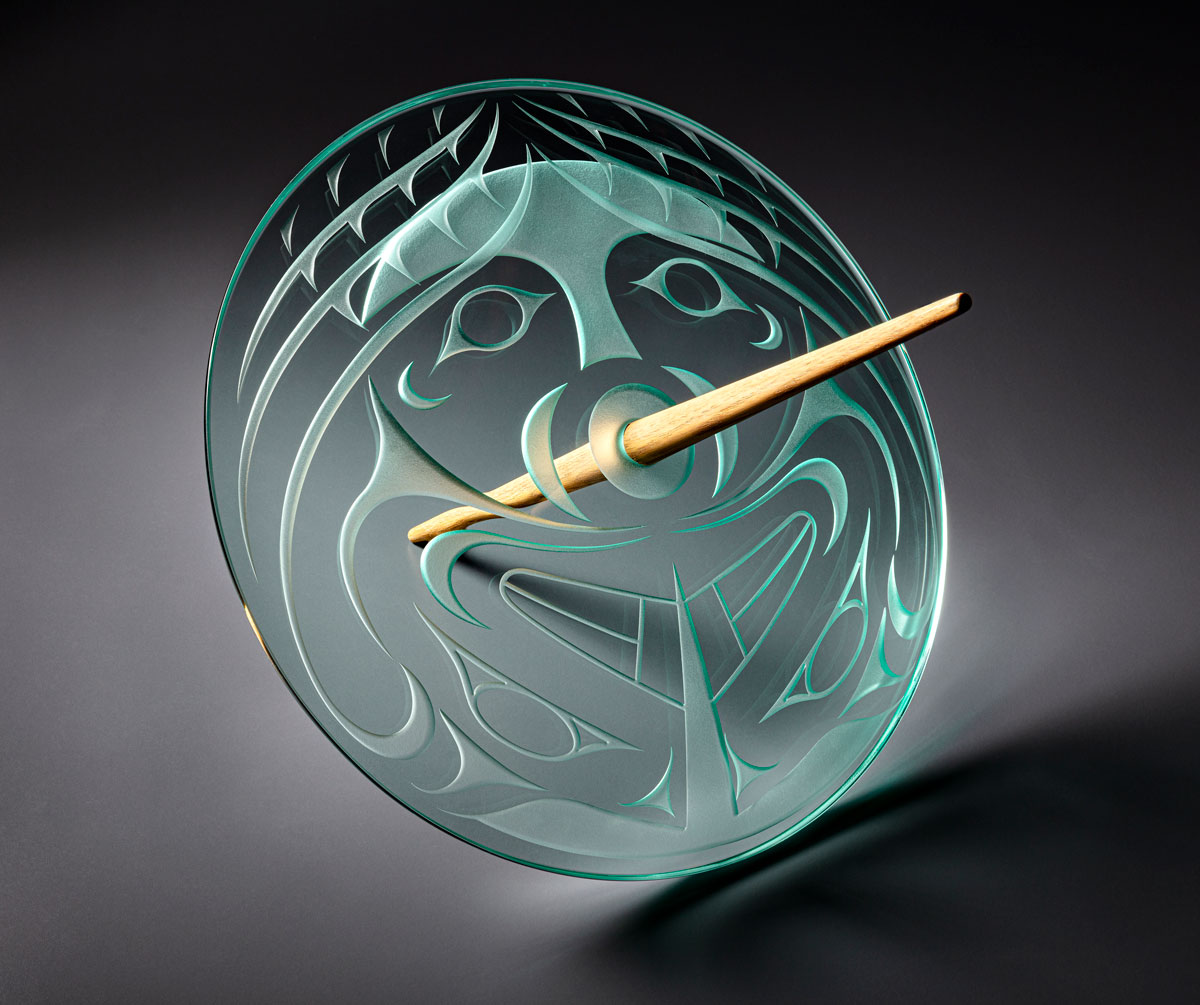
“Beaver Woman Transformation Spindle Whorl,” Susan Point, 2000; kiln-slumped and sand-etched glass, maple; 19" in diameter.
In the collection of Janet and Stephen Seltzer, Tucson, Arizona.
Courtesy of Susan A. Point
Carol Lujan (Diné)
Carol Lujan is on her second career. She began as a professor of Native American studies but has since developed as an artist who works with warm glass to create Diné (Navajo) blankets, masks, panels and bowls. Her work is notable for its strength of color and design.
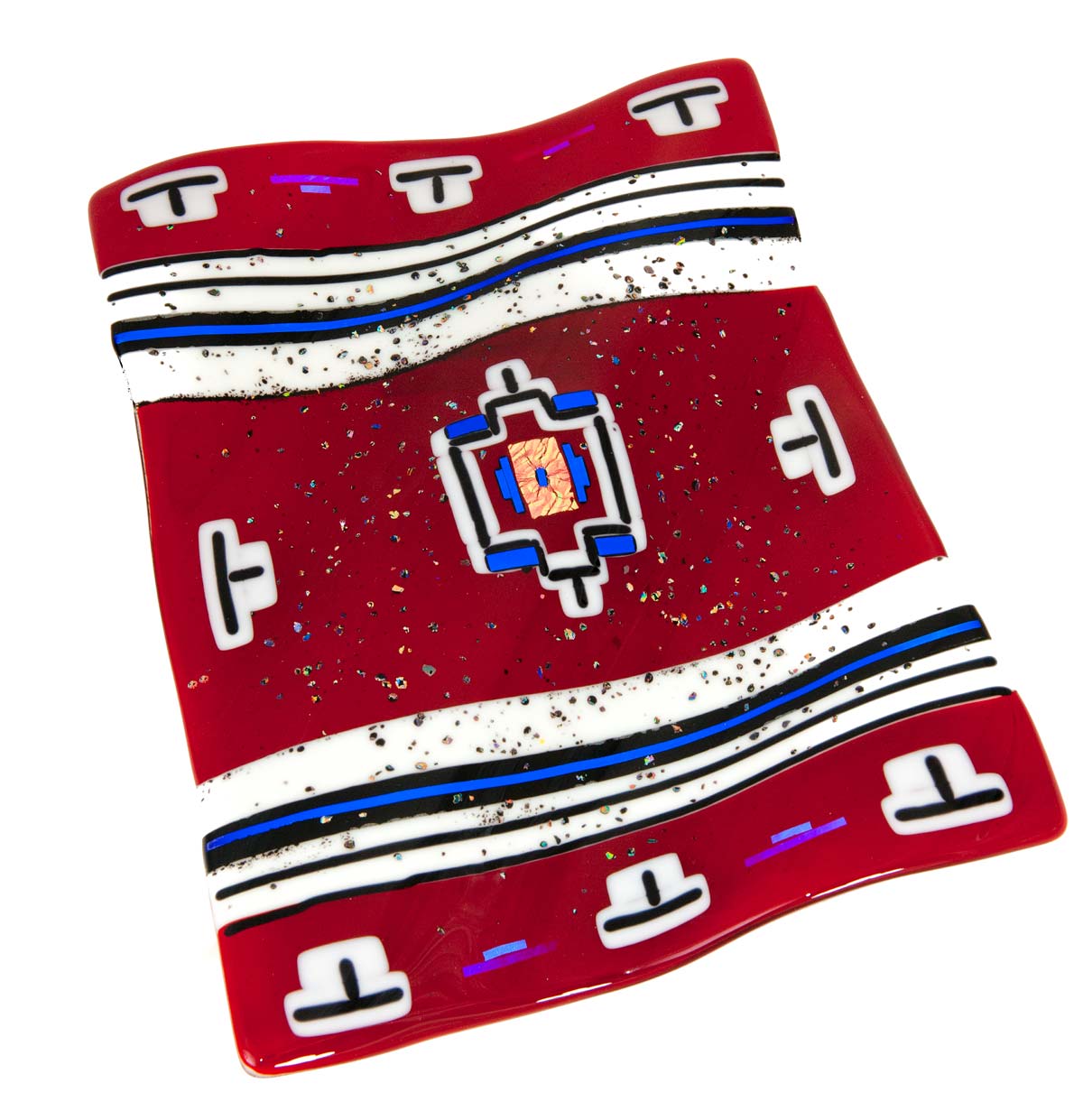
“Grandmother’s Legacy,” series, Carol Lujan, 2018; slump and fused glass; 14.5" x 12" x 1.5".
Photo by Stephen Lang, Courtesy of Carol Lujan
Gifts from the Sea
Indigenous communities living on islands and along the coasts of lakes, rivers and oceans are interconnected with marine life and share this understanding and respect through their art. The interplay of “land” (the materials that make up glass, with sand as a base) and water in these richly colored, blown-glass fish and sea animals honor that relationship.
Raven Skyriver (Tlingit)
Raven Skyriver grew up in the Puget Sound area of Washington state, where he developed his reverence for the sea and the life within it. In the book “Clearly Indigenous,” his blown-glass art is described as being devoted to “realistic, yet surreal sea creatures”such as this vibrant mahi-mahi and sea turtle.
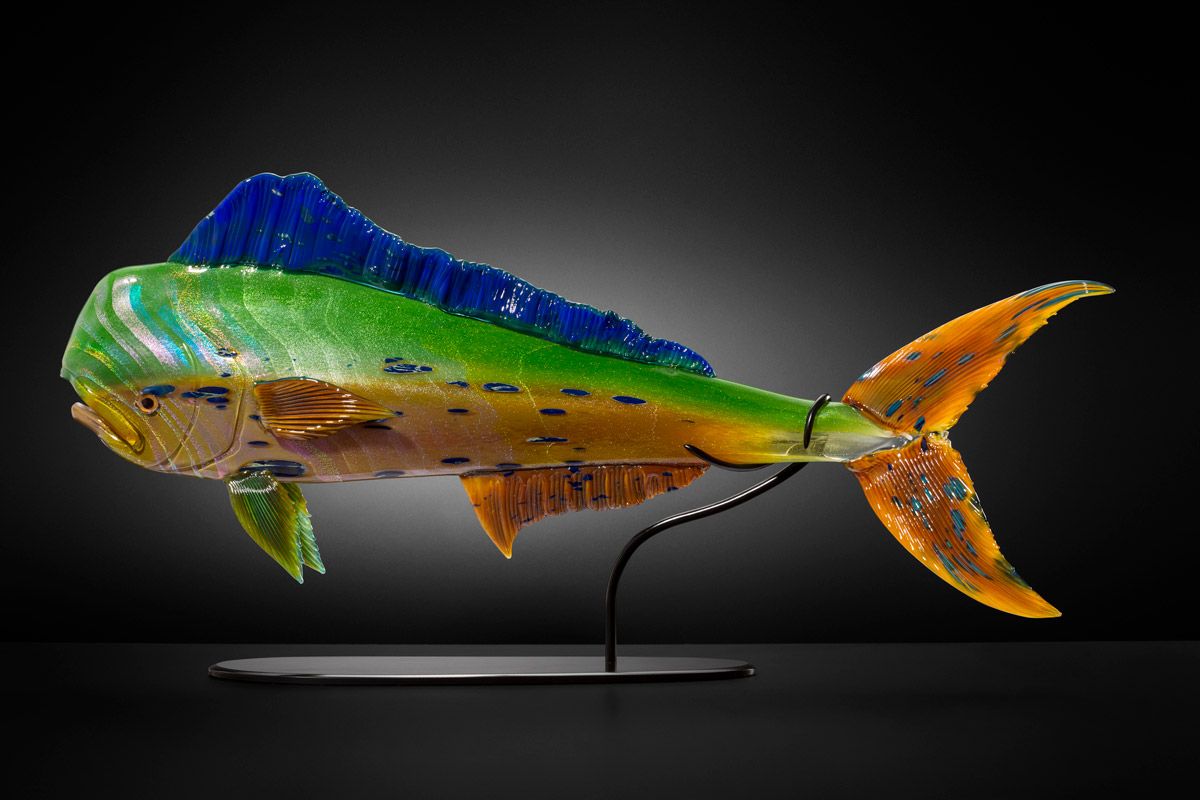
“Mahi Mahi,” Raven Skyriver, 2017; Offhand sculpted glass, 16" x 31" x 19".
Photograph by KP Studios, courtesy of Raven Skyriver
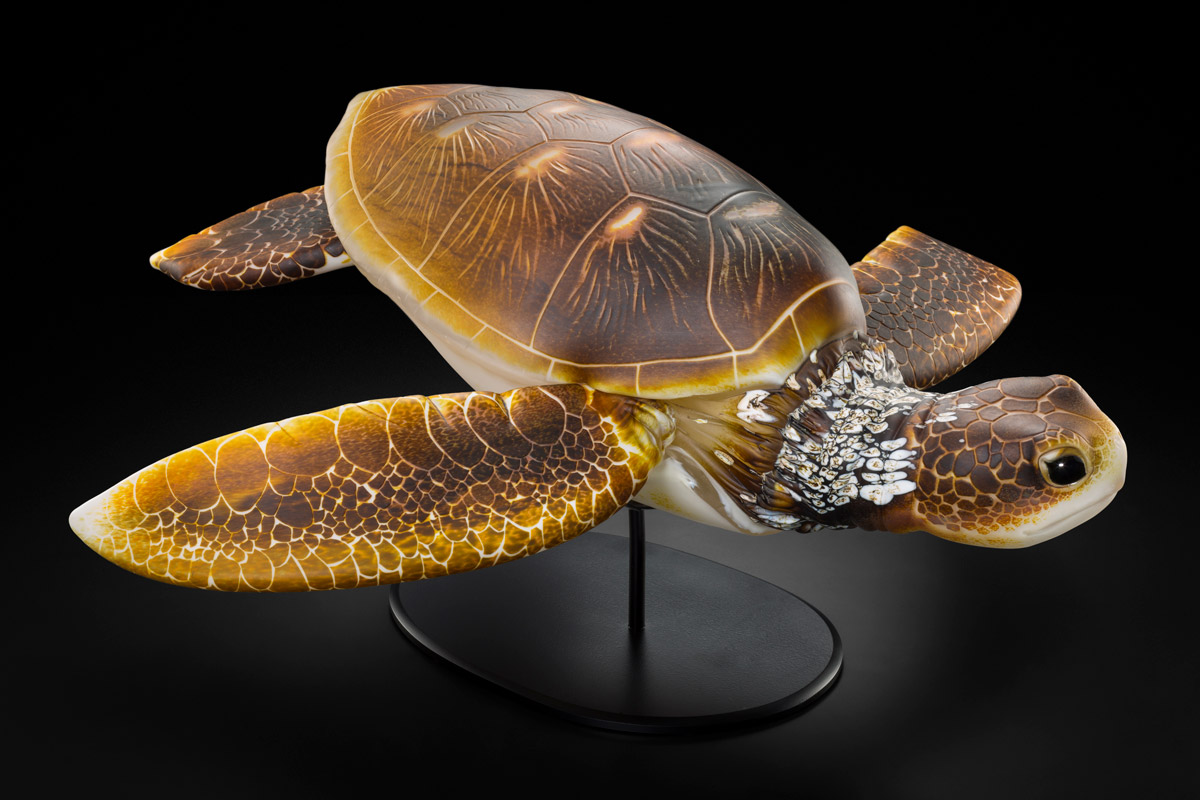
“Adrift,” Raven Skyriver, 2015; offhand sculpted glass; 18" x 24" x 27".
Photograph by KP Studios, courtesy of Raven Skyriver
Animals of the Land
The respect Indigenous peoples feel toward the animal world is a prominent subject in many Native glass art creations. Hunting protocols often include thanking the animal and explaining how its body will be used. Animals also provide spiritual guidance. To communities who live in wooded areas, bears can symbolize strength and courage, and wolves may signify protection.
Many Indigenous cultures refer to the North American continent as Turtle Island. In creation stories among Native communities in the Northeast, the turtle brought earth up from the underwater on its back, creating the continent in the shape of its own body. Turtle imagery has historically been seen on vessels, in drawings and as figurines and rattles.
Larry Ahvakana (Iñupiaq)
Larry Ahvakana is one of the first generation of Native American glass artists. He grew up with his family in Alaska but left home in his teens to study at IAIA and later at the College of Santa Fe in New Mexico. Throughout his career, he has created sculptures in many media, including glass, bronze, stone, wood and ivory.
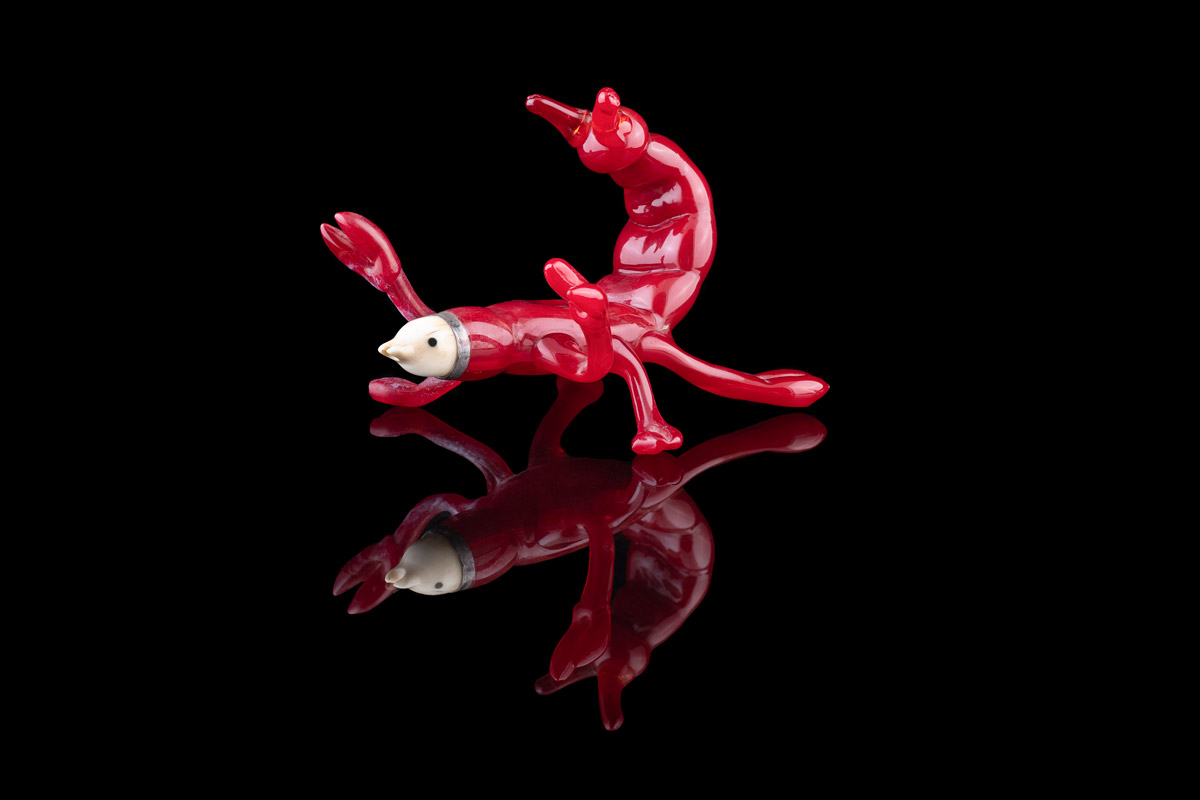
Scorpion, Larry Ahvakana, 1978; blown glass, ivory, metal, 5" x 8" x 3".
In the collection of Tony Jojola.
Courtesy of Tony Jojola
Animals of the Sky
Birds are important as a food source in Native communities, and they play primary roles in many Indigenous creation stories and other tales. Raven brought light to the world in the origin stories of several Northwest Coast tribes. Eagles carry prayers to the creator. Owls and other birds are featured in totems.
Artists sometimes express their respect for birds and other winged animals through depictions on everyday objects such as pottery and baskets. Butterflies, dragonflies and other colorful creatures of the sky are favorite subjects, whether in blown glass, cut and fused glass or as designs on vessels.
Preston Singletary (Tlingit) and Djambawa Marawili (Yolŋu [Aboriginal Australian])
Djambawa Marawili is a painter, sculptor and cultural leader of the Madarrpa clan. During his visit to Seattle from 2016 to 2017, he collaborated with Preston Singletary to create glass art such as this bird using designs from Marawil’s bark paintings, a traditional Yolŋu art form.
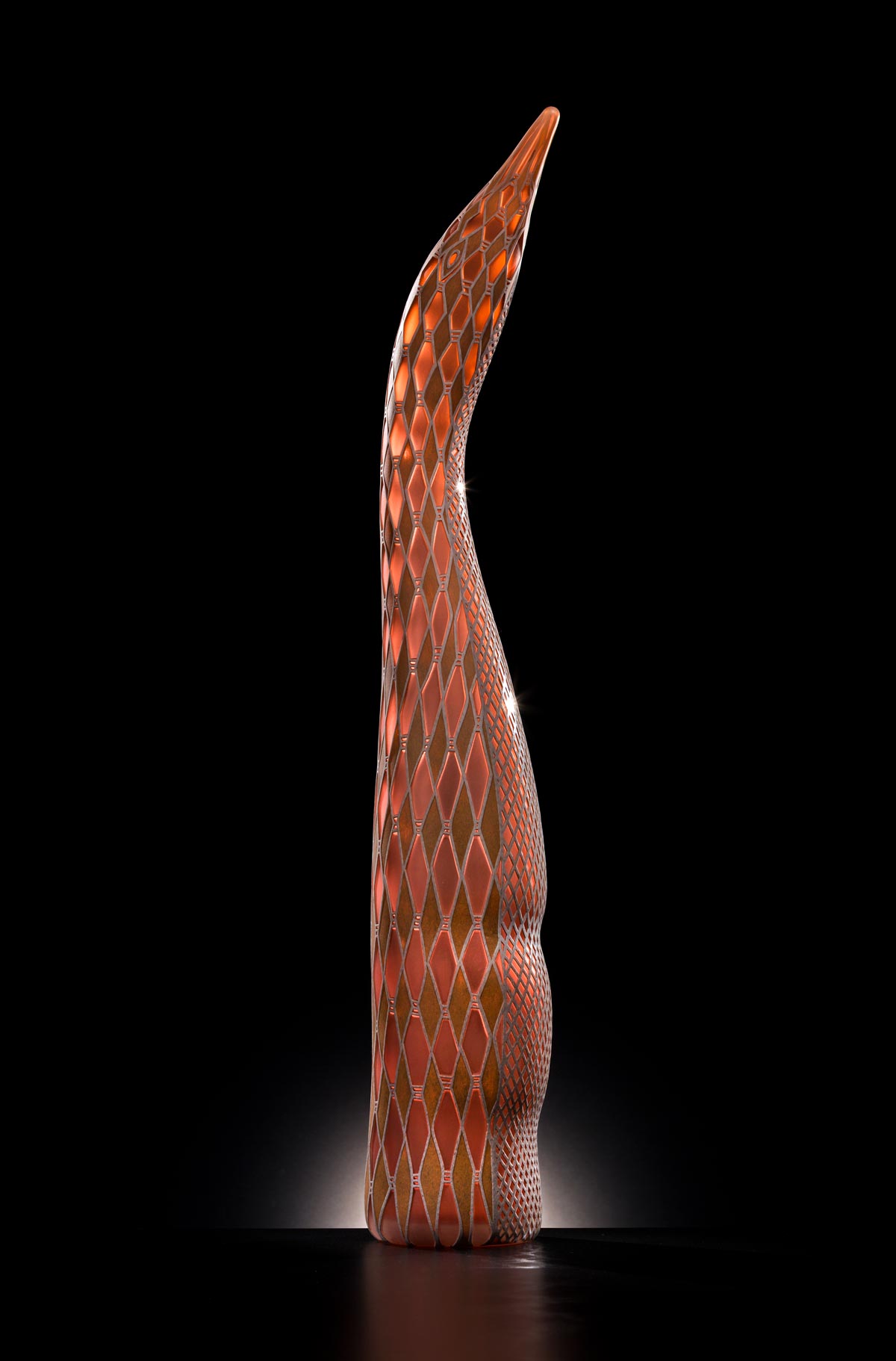
Untitled, Preston Singletary and Djambawa Marawili, 2017; blown and sand-carved glass. 32.5" x 5" x 5".
Photo by Russell Johnson/Courtesy of Preston Singletary Studio
Ancestors' Voices
Djambawa Marawili is a painter, sculptor and cultural leader of the Madarrpa clan. During his visit to Seattle from 2016 to 2017, he collaborated with Preston Singletary to create glass art such as this bird using designs from Marawil’s bark paintings, a traditional Yolŋu art form.
Lillian Pitt (Wasco/Yakama/Warm Springs)
Lillian Pitt is a well-known artist who works mainly in clay and bronze. In 2014, however, she was inspired by a famous petrograph and pictograph image to create “She Who Watches,” which features a lead crystal mold of one of her masks she had made in both clay and bronze.
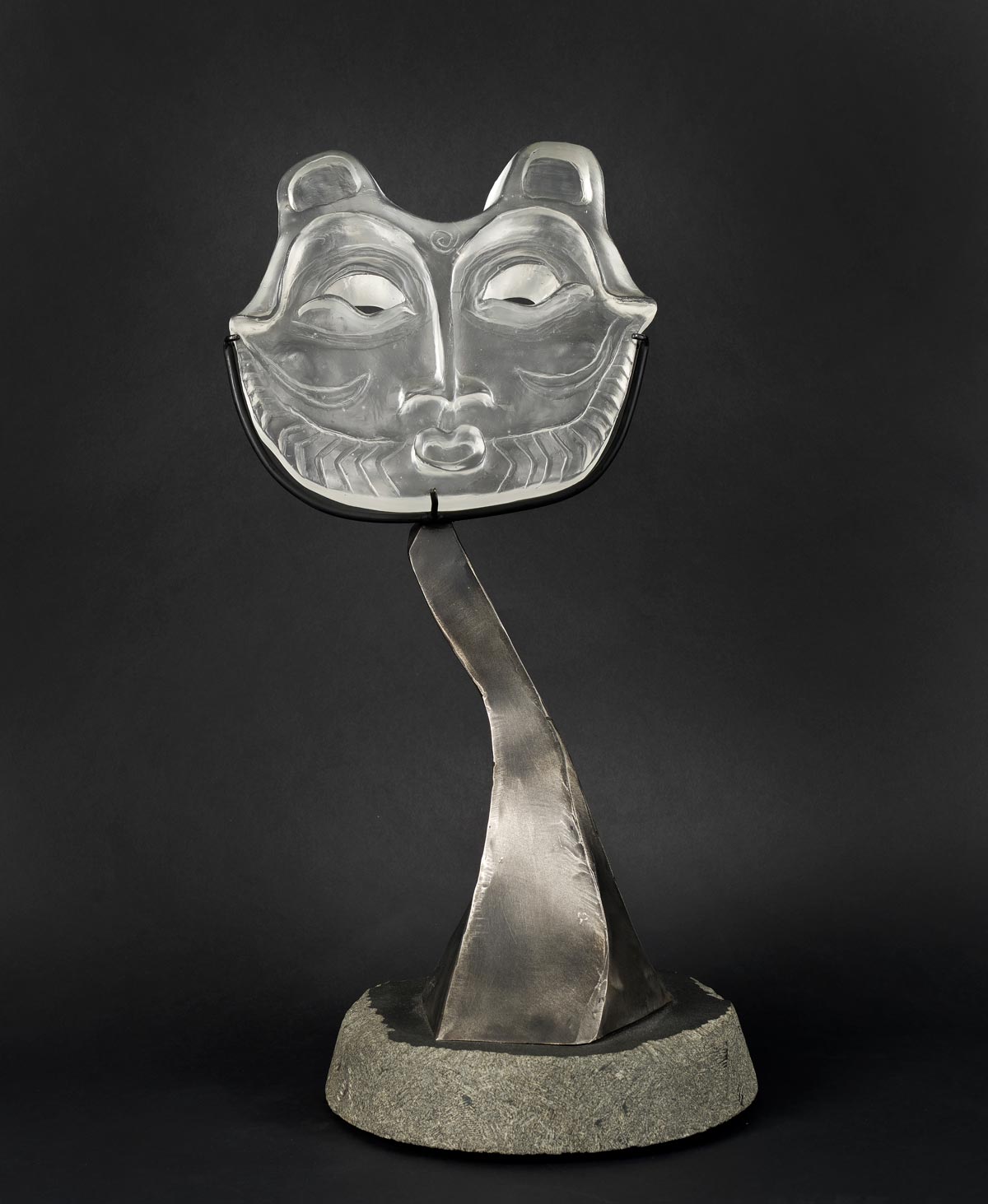
“She Who Watches,” Lillian Pitt, 2014; cast New Zealand lead crystal, steel and granite; 24" x 10" x 10".
Accession/catalog no. YI-34, collection of the IAIA Museum of Contemporary Native Arts, Santa Fe, New Mexico.
Photo by Eric Wimmer; Courtesy of Tatiana Lomahaftewa
Adrian Wall (Jemez Pueblo)
Adrian Wall’s preference for glass art is cast glass, combining stone and glass into his work. He began as a sculptor at a young age but diversified his interests into mixed media. His piece “The Story Teller” is a mixed stone and glass sculpture that uses petroglyph designs to tell a Pueblo creation story.
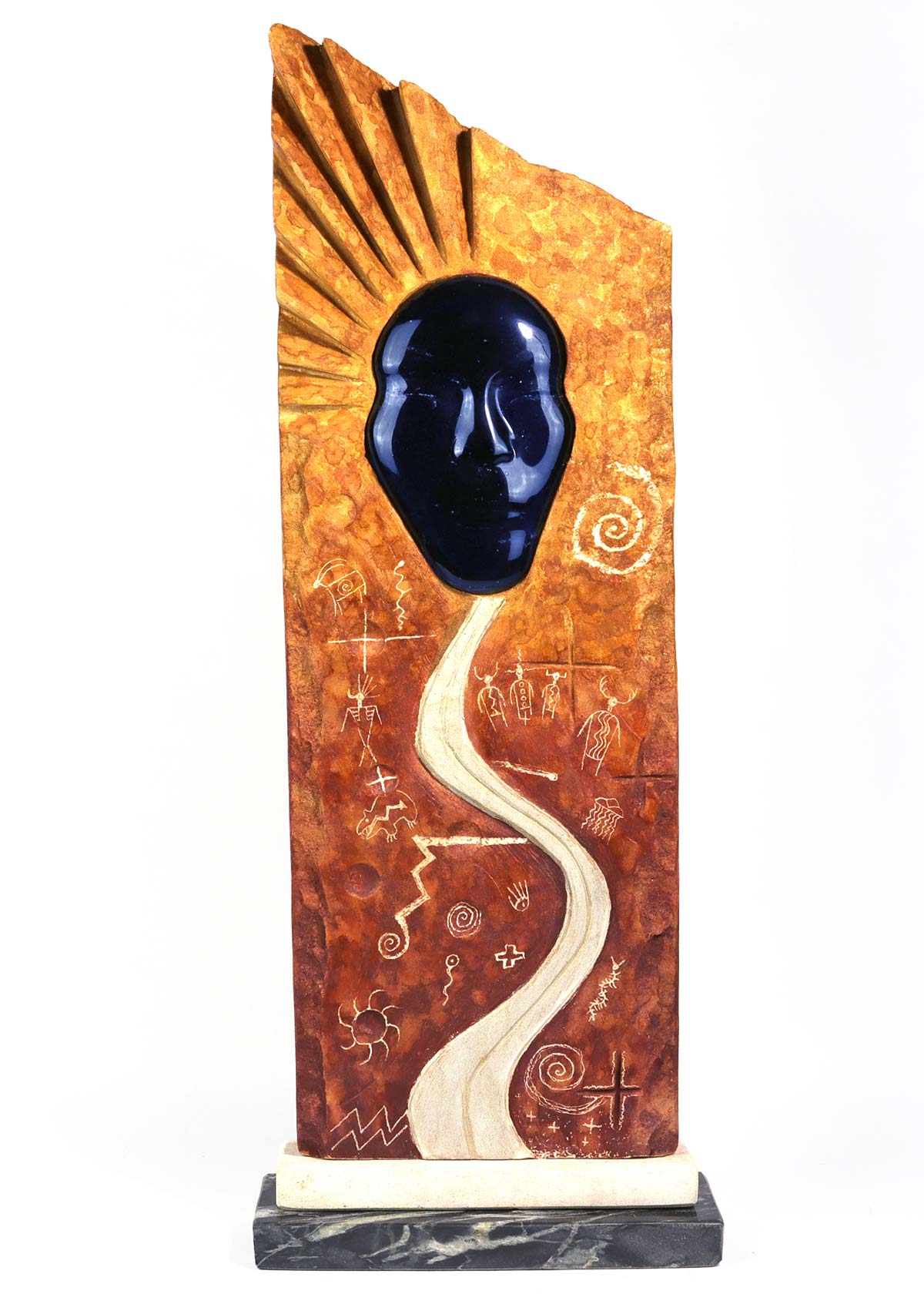
“The Story Teller,” Adrian Wall, 2019; cast glass, acid-stained limestone, 26" x 16" x 7".
In the collection of Wright’s Indian Art.
Photo by Adrian Wall
Contemporary Voices
Important works in the Contemporary Native Arts movement make bold statements that teach Indigenous values to the broader public. Whether reflecting on the differences between past and current-day tracks or markings on the landscape, recognizing the continuing symbolism of corn maidens or juxtaposing a traditionally clothed Inuit child with a changing climate, the art in this section provides pointed social commentary.
Ira Lujan (Taos Pueblo/Ohkay Owingeh)
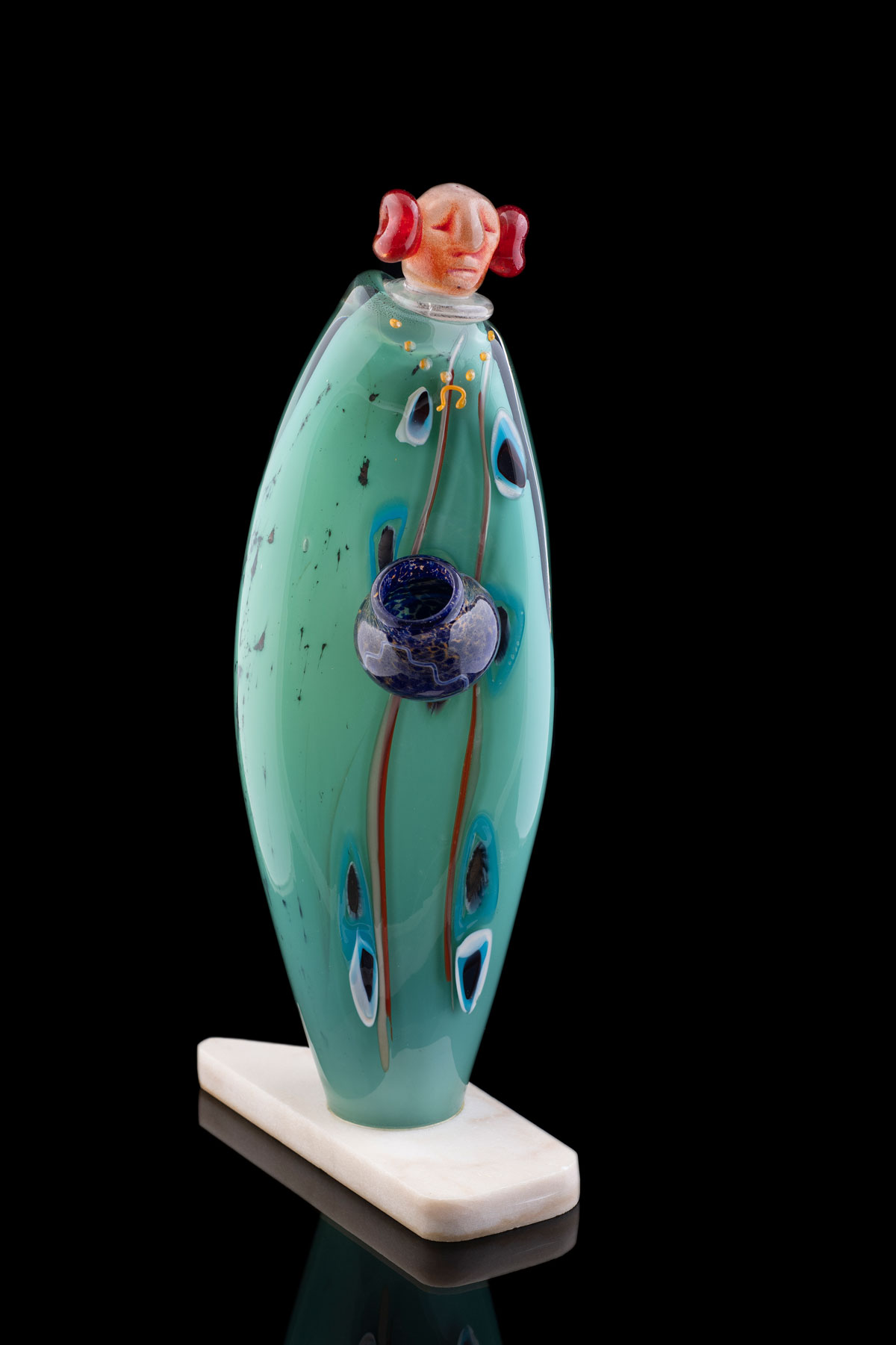
Ira Lujan grew up making ceramics. He learned the techniques for making ceramics and glass are similar, but whereas ceramics are smoothed with water, glass uses fire. Lujan was a student of Tony Jojola, who suggested he incorporate Pueblo themes into his work. Lujan continues this today with designs of traditional utilitarian objects like vessels used to carry water. He also has been inspired by other Southwest cultures, such as when he created this “Hopi Maiden.”